Increased adoption of IoT and increased population use of technology are expected to fuel the growth of wearable technology according to market analysis during the forecast period. Recent years have seen market growth due to increased technological literacy. It is predicted to continue in the coming year as well. Increasing consumer awareness will lead to a rapid expansion of the market. Also as purchasing power rises, more people are looking to invest in wearable technology.
Innovative products and solutions have been developed in this industry through constant research and development and contributing to its growth. In the coming years, the market will grow due to the advanced features available with these variable devices.
Statistics of Wearable Technology
- A 38.6% market share was held by North America in 2021.
- Global wearable technology market growth is forecast at 13.89% over the forecast period of 2022 to 2030.
- A 48.6% revenue share was contributed by the consumer electronics application segment in 2021.
- A CAGR of 10.7% is forecast for the fitness and wellness segment of wearables between 2022 and 2030.
- 49.2% of the market share in 2021 was held by wrist-worn products.
- A higher CAGR of 14.3% is expected for the eyewear and headwear product segment from 2022 to 2030.

How do industrial wearable devices add value to businesses?
Industrial wearable devices are designed to streamline operations, boost productivity, enhance worker safety, and optimize processes by providing real-time data. By incorporating wearable technology, businesses can increase efficiency and save costs. Hands-free technology also empowers workers and allows for improved communication and collaboration among teams.
Onboarding and training processes have been accelerated and communication loops have been compressed. Among the specific applications are:
Improving plant efficiency
By tracking employee movements, processes can be redesigned and optimized to increase plant efficiency.
Increasing safety
They can also assist in ensuring that rotation occurs as planned, reducing the risk of injury due to fatigue or excessive work.
Reinventing training
Wearable technology can be used as a training aid when onboarding and training new employees.
Using remote experts
Wearable app development can impact industrial processes by enabling remote experts to advise and guide on-site personnel. Remote facilities can benefit from niche expertise in minutes instead of days caused by cross-border travel.
What technology is used by industrial wearable devices to transmit data?
Many wearable monitoring devices transmit data using a low-range RF signal. Wearable devices continuously stream processed and unprocessed data and are expected to work indefinitely, regardless of Internet connection availability. Wearable app development creates technological challenges for businesses, related to data volume and offline processing.
In what ways can wearable technology enhance Metaverse experiences?
The Metaverse will be enriched by wearable technology, which will allow multiple devices to communicate with each other. Users will be able to experience the virtual world through a new lens by combining AR and VR technology with 3D spatial sound and movement. Wearable technology would benefit metaverse experiences ranging from entertainment to education – greater immersion leads to greater engagement.
Watches have a lot of potential as a Metaverse device because they can be combined with headsets and other devices to create new and innovative experiences. The extent of its functionality can far exceed the current smartwatch, from producing 3D maps to projecting video calls from your wrist.
Wearable App Development Trends
What are the major trends and debuts in wearable technology in 2022 and beyond?
Through the evolution of technology, human minds and skills have been set to automate processes and realities in a variety of industries and types of employment. App development is contributing significantly to this by accelerating industrial growth. Every mobile app development company in the midst of this growth is now focusing on wearable technology for future-oriented app development.
Although wearable technology is now quite old in terms of technology, it has begun to change app development trends and versatility to provide optimal performance.
According to a research, by 2022, 25% of the adult population in the United States was using wearable technology. This highlights the importance of multi-platform connectivity as well as some useful, user-friendly features.

IoT Integration
A digital web of interconnected devices, known as the Internet of Things, is a digital platform for seamless data exchange. While the primary reason for this is to automate logical computation for better living, it also serves a variety of other user needs.
GPS Wearable Technology
GPS and location-based services are also making inroads into the development of wearable apps. GPS technology could fuel the future of wearable app development in the coming years, ushering in technologies such as self-driving cars.
Contactless Payments
Contactless ePayments are one of the notable updates in this space. Wearable applications could be crucial in providing various aspects of online payment. This integration has the potential to have a significant impact on industries such as eCommerce, restaurant management, and so on. In addition, the banking and finance industries could use wearable contactless payment devices to make payments more convenient.
Artificial Intelligence
AI has influenced how people interact with mobile devices, conduct businesses, and perform various tasks by ensuring automation, interactivity, and personalised solutions.
Similarly, artificial intelligence in wearable technology would provide quick and automated solutions. AI in wearable apps would improve service quality by eliminating errors and bugs while also ensuring efficient service delivery.
Technology of Sensors
Sensor technology has been widely used in the development of wearable apps for many years. Sensor technology has done it all, from enabling innovative functionalities to ensuring personalised services and data provision. In the healthcare industry, for example, sensor technology has enabled heartbeat counts, blood pressure measurement, calorie intake measurement, and more.
Similarly, fitness-tracking wearable devices track pulse rate and the number of steps taken per day using sensor technology. Aside from the healthcare industry, several designers are working to get the most out of sensor technology by emphasising user engagement and enhanced UI/UX features.
Technology of Beacons
Beacons are low-cost transmitters that use low-energy Bluetooth to send signals to nearby electronic devices. Beacon devices provide effective and simple connectivity with other electronic devices in the vicinity in order to share information and facilitate location-based searching.
Although the technology has been widely used in smartwatch development, the trends will continue to grow this year. Furthermore, when compared to GPS services, this technology provides more advanced and precise locational results.
Data Safety
Since cyber threats and bullying have recently increased, the process of wearable app development could include data security measures. Any data that appears suspicious or has the potential to produce unexpected results can be evaluated and limited in order to avoid potentially dangerous situations.
Conclusion
Wearable technology has a lot of potentials, which is perhaps its most intriguing aspect. There are no limits to innovation. Wearable devices will be the next stage of evolution, in the footsteps of mobile phones.
If we talk about Metaverse wearables, watches and wristbands are frequently overshadowed by the concept of AR/VR headsets, but they will undoubtedly play an important role in how we experience the Metaverse in the future.
New players are entering the wearable market with better products and services to meet the varying needs of consumers. However, in order to sustain demand and maintain user trust, manufacturers must seriously consider a number of concerns. With people becoming more aware of these devices, it is difficult to ignore the critical issue surrounding these devices.
Since wearable app development is developing as a new tech invention, this industry may experience additional new trends and developments. Way2Smile Solutions is a leading App Development Company in Chennai that offers wearable app development services to global organizations.
If you have a game-changing product idea, you may have already considered developing a cross-platform application using contemporary mobile app development languages. However, there’s a good chance that wearables app development hasn’t even occurred to you.
People increasingly turn to wearable technology as smartwatches and other internet-connected devices become more popular. This is because they need to stay connected and track their activity. For instance, if we were to talk about physical activities, running with your phone in your hand or in your pocket is inconvenient and nearly impossible to swim with. However, it advanced the mobile phone’s water-resistance capabilities.
Wearables have become popular due to their appealing features and convenience. No matter how good your product is, if it does not penetrate deeply into your everyday customer’s life through smartwatches, smart glasses (Google Glass), fitness trackers, and so on, your customers are likely to go to your competitors rather than wait.
Keeping your customers’ ever-changing demands in mind, this article answers all of your questions about the wearable app development process – how much it costs to develop a wearable app, and how to design your wearable app.
In this blog, we’ve wanted to give you a step-by-step guide on the bespoke wearable app development process, covering everything you need from the very beginning to the myriad applications of the technology.
Dive right in!
What You Need to Know About Wearable Apps
Let’s face it, when it comes to wearable app design, Apple Watch software has dominated the market for years now. On the other side, Google recently purchased Fitbit and then partnered with Samsung to develop a more advanced wearable OS. The new operating system will succeed Google’s Wear OS and Samsung’s Tizen.
Globally, 1 billion wearables are connected.
According to surveys, this market will continue to expand. It is expected to exceed $265 billion by 2026, growing at a 18% CAGR between 2021 and 2026.
Wearable devices are expected to generate $128 billion in revenue globally by 2027.
4G smartwatches will account for more than half of all device shipments in 2023, with 5G wearables following in 2024.
Benefits of Wearable App Development for Business
The advantages of wearable technology for business are determined by your objectives and target audience. You will receive the following benefits if you invest in wearable app development solutions for your customers and end-users:

Increased employee productivity
Wearables can increase employee productivity by reducing non-value activity and allowing workers to fully focus on the job for which they are qualified, which is critical for good time management in any business.
Better communication
Smartwatches, for instance, enable push notifications and other methods of being notified of an important update in real-time, with even options for responding.
Better customer service
Customer service and satisfaction can be improved with wearables. Data such as biometric information, location, spending and purchasing history, etc. can be collected. Based on customer interaction and payment data, retailers can modify their processes accordingly.
A Step-by-Step Guide to Developing a Wearable Application
Wearable applications are difficult to develop due to specific limitations, so it is important to plan development from a technical perspective. Business logic forms the basis of all future functionality, so it is even more important to focus on the business component. Here is a guide on how to plan, develop, and launch a wearable app.
Discover your use case
Before looking to build or outsource the wearable app development process, you should know exactly what you want. There are several use cases for various devices, and we recommend starting with a succinct proposal that addresses one or two use cases.
You can accomplish this by conducting a series of studies, which include:
- User persona research
- Market investigation
- Competitor analysis
- Target audience
- Product-market fit
Locate a dependable vendor
There are numerous approaches you may take to identify the best wearable app development company for your budget and requirements:
- Get recommendations from friends or partners
- Use web directories to find reviews
- Obtain information about potential providers from their websites and their portfolios
- Look for a professional content and make contact with possible vendors
To expedite your search for the finest wearable app development firm, you can also create an RFP (request for proposal), in which you will explain your concept and ask questions about the company.
Select a platform for your app
Wearable technology is a vast field, and it is easy to become lost among the different types. Typically, wearable app development platforms are device-specific. To support each device manufacturer, you will need to create a separate application.
Let’s take a look at the most popular platforms for various types of wearable devices: Smartwatch platforms include Apple WearOS, Android Wear, HarmonyOs, etc.; fitness tracker platforms like Fitbit; And, smart glass platforms like Glass OS, HarmonyOS, Epson Moverio and Sony SmartEyeGlass.
Smart rings, smart clothing, and other wearable devices also exist. These are only three types of wearable devices. An agency that develops wearable apps can advise you on which platform is best for your business goals and target audience.
Design your wearable app’s UI and UX
The user interface and user experience of wearable apps differ greatly from that of mobile UI/UX design. That is why it is critical to hire a designer with experience creating UI/UX for wearable devices. Wearable devices are much smaller than mobile devices, and they have fewer controls and UI elements. Similarly, make the UI elements large enough so that users can navigate the app with their fingers, but do not make them too small.
- Make sure that all of your interface’s key elements are visible at a glance.
- Make your interface easy to understand by using simple fonts and a minimalist design.
- Avoid complicated fonts, minimalist shapes, and dull colours.
Consider battery consumption
Developers of wearable devices must go above and beyond to reduce battery consumption by their apps since the batteries are less powerful than those in mobile devices. They should also consider memory consumption. Developing lightweight and easy-to-load code will help developers overcome these challenges faced by wearable devices.
Take care of security as soon as possible
Before launching a wearable device development project, plan your security strategy. This aspect is especially important when developing wearable apps in healthcare since they need to comply with regulations such as HIPAA. If you are not concerned about the security for your system, hackers can access user data via WiFi, particularly on public networks.
Here are some other things to consider when making your wearable app secure:
- Data storage and encryption
- Camera access
- Wireless connectivity
Select the type of wearable app you want
The distinction between these types is based on their independence from a mobile device, as well as their operational logic and functionality. These apps are completely separate from mobile devices.
The companion app is created in tandem with mobile applications. They have limited functionality and constantly exchange data with a mobile application. With companion applications, a wearable device can be managed using a mobile phone.
Businesses typically create either standalone or companion wearable applications but not both. You need to talk to a wearable app development company that specializes in both.
Make a list of features
Determine the functionality of your future application and prioritize the features to know what to develop first. A typical wearable application has the following features:
- Push notifications
- Navigation and controls
- Voice commands
- UI UX elements
- Data from sensors
- Settings
Also, if you want to create a companion app, you’ll also need to develop a smartphone application as well if you don’t have one already. For standalone wearable apps, you may need to develop a container app that carries the setup process. However, most smartwatches are able to connect to the internet and install an app directly from the app store.
Choose your technology stack
You must carefully select other technologies for your app, such as SDKs, APIs, libraries, and programming languages, in addition to the operating systems for your target devices.
Create, launch, and maintain your app
After choosing all technologies, features, and platforms, the most difficult part is over. Before releasing your application to the app store, you need to develop and test it. For your application to remain secure, usable, and relevant, you must maintain it regularly. The wearable software should be updated regularly for security and performance, be adapted to new operating systems, and use the latest third-party libraries.
Challenges and corresponding solutions in the wearable app development process
Developing a wearable app is a difficult task. It necessitates knowledge of both hardware and software engineering. There are several distinct challenges associated with developing wearable apps that you must consider.
Recognizing wearable device limitations
Understanding the device’s limitations is one of the most difficult aspects of developing wearable apps. When compared to smartphones, wearable devices typically have lower battery life and storage capacity.
As a result, app developers must be mindful of how they design their apps to work effectively within these constraints. Furthermore, developers must be aware of the device’s hardware specifications to ensure that their app runs smoothly on it.
Creating interaction design
Designing for interaction is another challenge for app developers. Users use wearable devices to quickly check information and notifications. Users should be able to easily find what they need and take action by having a seamless and simple user experience.
App developers must consider how users will interact with their apps on small screens. The best way to make the user experience as simple as possible is by using gestures, voice commands, and other forms of interaction.
Creating interesting content
Users will spend less time engaging with wearable apps if all they allow for is their assistance during day-to-day interactions. App designers must be inventive. Find ways to deliver engaging content that will quickly capture the user’s attention and keep them returning – This is especially critical in the world of wearable technology.
Making certain of device compatibility
Wearable apps must also be cross-platform and device compatible. Developers must ensure that their app functions properly across multiple operating systems such as Android Wear, Apple WatchOS, and various other types of wearables platforms.
As each platform now has its own set of guidelines and standards for the wearable app development process, ensuring compatibility between all of these devices can be a difficult task.
Intuitive user interface
Another, difficult challenge for developers when developing wearable apps is creating an intuitive user experience. Wearable devices are typically designed for on-the-go use and require quick, and simple interactions. As a result, you should create a user interface that is both intuitive and efficient, allowing users to complete tasks quickly and without having to think too hard about it. Furthermore, wearables frequently have smaller screens. It is difficult for developers to ensure that the information presented is clear and easy to read.
Device dimensions
This entails designing the app so that it can operate in both circular and linear modes. Do make use of the expertise of your chosen wearable app development company to overcome this obstacle.
What Are The Types of Wearable App Development in Technology?
Wearable app development refers to the creation of software applications for wearable devices, such as smartwatches and fitness trackers. These apps can range from simple utilities to more complex programs and can be developed to support a variety of mobile app ideas, including health and wellness, productivity, and entertainment.
Let’s take a look at the most common wearable technology types that have changed consumer behaviour, as well as entire industries.
Smartwatches
Initially, smartwatches were associated with tracking and monitoring physical strength using wearable app development for fitness. However, their application has grown since then. They can now receive emails, play multimedia and games, transfer files, and even function as smartphones. They are highly commercialized and usable across the spectrum.
Health and fitness trackers
In addition to monitoring heart rate, blood pressure, calorie consumption, and distance, fitness trackers also provide other health-related information. Mobile apps allow fitness trackers like Fitbit to track data more accurately, so users can be confident that their readings are accurate. Wearable app development in Fitbit includes high-tech prosthetics and embedded electronic monitoring devices and are becoming more common, even though life-saving technology such as pacemakers has long been part of medicine.
Head-mounted displays
Head-mounted devices are one of the more obvious examples of VR glasses in wearable technology.
Use Cases For Wearable Applications
How can wearable software be used? Smartwatches are the most personal electronic devices people own. Taking advantage of this fact is crucial for business owners.
Wearable apps have the potential to provide a plethora of use cases that can be customized to meet the needs of each user.
Education
The potential for using wearables in education is enormous. Businesses that want to provide their own signature product in this field have a great opportunity to benefit schools and universities. Even low-income educational institutions could afford these wearables, which can provide levels and dimensions of education that would normally necessitate a much larger investment.
Emergency Services & Rescue Operations
Wearable technology such as smart glasses and smartwatches can warn first responders of impending dangers and provide information about their quarries’ general condition as well as the state of their surroundings.
This would help them mount more efficient rescue operations, regardless of the kind of emergency.
Defence Operations
Wearable technology can provide groundbreaking new opportunities for more efficient warfare and or other military operations that require stealth and real-time information. Even if fiction, a HUD (heads-up display) like the one in Ironman’s helmet is not a far-fetched dream now.
Healthcare
Doctors and surgeons can use similar technology and interfaces to assess any given patient’s health conditions in real time. Advancements in wearable app technology might even allow for traditional scans and tests to become obsolete.
The opportunities with wearable technology and wearable app development are endless.
The Features of Wearable App Development
Any business owner needs to know the features of their products to increase sales. This is also true with wearable app development. Wearable software technology is more appealing to people because it allows them to do more. Below we’ve listed some features that are helping businesses gain financial success with the apps.
- Each notification, alert, and update can be customized to suit your needs.
- Useful and easy to explore
- Sensors that track location via Bluetooth
- Transparency
- Simple to use
- Data and privacy protection
How much does it cost to design a wearable application?
App development costs for wearables vary but can have similar benchmarks as the standard industry pricing for mobile apps. In some cases, developers include it as part of the development costs of mobile applications. Wearable app development costs can vary depending on your needs and what exactly you do in your business. Also, you should consider what functionalities your wearables will include and whether the development will be outsourced to another country. Your wearable products should be budgeted for higher costs and complexity if this is the case. Prices rise as challenges become more complex and demand rises.
As a result, expert advice suggests hiring a dependable outside developer for smoother software production. There are many factors that affect the cost of wearable app development devices, including features, the number of platforms, design complexity, development approach, etc.
How can Way2Smile Solutions help?
Mobile technologies have expanded their horizons through wearable technology for businesses. Wearable devices have emerged as a result of constant innovation in the mobile sphere. It enables users to get correct information from anywhere at any time.
Way2Smile Solutions is a leading mobile app development company in Chennai. SMEs, entrepreneurs, and enterprises of different domains can get customized, robust, user-friendly, and scalable solutions from us. We specialize in creating mobile apps for both android and ios that don’t impede wearable app user experience due to limitations.
We can help in your wearable app development process by
- Building feature-rich, reliable, and secure wearable apps for both Android and iOS
- Implement a wearable-compatible version of your current app based on your business needs
- Develop wearable apps from start to finish
- Reduce the operational and development cost
Conclusion
To summarise, every wearable company is pursuing its potential and bringing new ideas to life for the benefit of humanity. In addition to tracking health, location, and other features, wearable apps offer a variety of features. For these apps to be developed, it is necessary to understand the various components of wearable technology. You’re an expert in using wearable app development tools if you’ve practical knowledge of developing wearable devices.
An app’s development involves creating a user-friendly interface, writing code, and testing it for performance and compatibility. A thorough understanding of the user experience and use case scenarios is required for successful wearable device app development. Businesses can use this new form of technology to gain an advantage in their industry by following the necessary steps to develop a successful wearable app. They will become easier to develop, integrate into existing platforms, and provide more advanced features as they become more accessible. Developers seeking breakthroughs in wearable apps are on the verge of a great revolutionary leap in the coming decade.
Even though creating wearable apps appears to be difficult, it is also lucrative. Get started on your mobile app development with Way2Smile Solutions, who can assist you if you are looking for wearable app development solutions.
Frequently Asked Questions (FAQs)
Battery life
Ergonomics
Security issues
Functionality
Multi-Platform is not supported
Regular updates
User interface
Wearable devices can be protected by taking the following steps:
Make adjustments to the privacy settings.
Take a look at the privacy statement.
Limit the information you share and turn off location tracking.
Enable software updates and use a password.
Old devices should be wiped of personal information.
For instance, wearables allow freelancers to scan business expense receipts and forward them directly to their clients’ expense accounts.
Introduction
Recently, the smartphone industry has introduced foldable technology for smartphones. The impact is far-reaching, despite how it looks at the surface. Users can create immersive and detailed experiences because foldable phones use multi-window APIs. For example, apps that offer video streaming can utilize increased screen size to rotate videos in a more substantial orientation or to provide additional controls and features.
Global smartphone markets are being reshaped by foldable smartphone app development. Despite the fact, that it provides valuable features and functionalities to customers, the foldable device ecosystem is still at an early stage. Apps for foldable devices are expected to become increasingly popular in the high-end smartphone market.
The market saw the introduction of a new player after Samsung debuted the Galaxy Z Fold in 2019. This one-of-a-kind design has arrived to break up the monotony of traditional smartphones. Will foldable devices replace modern smartphones? Everything hinges on how well they perform.
If you’re looking for a proper approach to deal with both the design and development sector of applications for these versatile devices, this blog will come in handy. Here are the considerations and changes we must make when developing apps for foldable mobile app solutions.
Flexibility is essential when developing foldable apps
Operating systems are preparing to enhance smartphone experiences as the era of flexible smartphones dawns. However, the challenge is to make the experience seamless for both 2 screen and single-screen devices.
Here are a few things to consider when designing foldable mobile app solutions.
Two-screen mobile app screen
Every foldable app is available in two states such as folded and unfolded. The extra app space available could be used for other necessary actions.
Multitasking ability
Simultaneously, a mobile device can run two applications but more than three applications require additional consideration. Multi-window mode is therefore prioritized by mobile app development companies.
Adjustable mobile screen
There are foldable phones with small and heavy screens available. In such cases, it was discovered that the app that was frequently used had its activities resumed.
Test all potential scenarios
Compromises on application orientation, screen resolution, and so on would be a bad idea. Choosing what is workable for you is required to build an impenetrable application.
Ensure the uninterrupted app experience
When converting an application’s screen from folded to unfolded, a smooth transition is required. Any interruption during the process may force users to uninstall an app.
Application development
Since you use your phone to explore different mobile apps and everything else on your device, an app must be designed accordingly. The design parameters will undoubtedly change as a result of this. Consequently, low-cost mobile app development needs to be a priority.
What are the main considerations for developing apps for foldable smartphones?
Folded State
When folded, it resembles the current phone, which can be operated with a single hand. Every OEM approaches this experience differently. For example, the Samsung Galaxy Fold employs a separate 4.58″ screen known as the Cover Display, whereas Huawei employs the same screen in a folded technology state.
Unfolded State
Even, if it takes a different approach to dealing with the experience. For example, In Galaxy, the phone unfolds inwards, whereas Huawei unfolds outwards.
One-Handed / Two-Handed Mobile Design
As the state changes, so does the experience. A mobile device can usually be operated with one hand, but when unfolded, two hands would be required. In the current devices, even unfolding the device requires two hands.
Multi-window
There is a lot of space to work with. To develop a multi-window app for foldable mobile devices to enable multitasking, so we must always consider all the applications a user may be running in addition to the apps we design.
What are the challenges faced by foldable smartphone app development?
Let’s examine the challenges that foldable mobile technologies will present to designers and developers.
- App UI accessibility issue
- Multiple windows running simultaneously
- Workflow experience
- Adjustment of screen ratio
- Switching orientation
- Thickness
- Curve
- Screen durability
Difference Between Foldable and Non-Foldable Smartphones
| Foldable smartphones | Non-Foldable smartphones |
|---|---|
| The display is split into two panels that connect with hinges. | A standard flat-screen display is displayed on the only screen. |
| A second full-size display will provide more screen space. | The work is done on a single screen. |
| Multiple apps on two different scenes can be multitasking better. | No extra space on the screen between the two apps. |
| Contrary to regular ones, these are thicker and heavier. | Compared to folding models, they are slimmer and lighter. |
Step-by-Step Process of Developing Foldable App
The foldable smartphone app development goes through 6 stages.
1. Market and competitor research
It is impossible to develop an app without first conducting market research and identifying competitors. This stage will help you get answers to the following questions:
- What industry would you like to see a foldable device app developed for?
- What advantages will your app offer users?
- What feature would you like to add?
2. App concept verification
Knowing the answers to the questions above will allow you to finalize the app concept, and start deciding on the final list of features, how users will interact with your app, and the unique selling point.
3. App monetization plan
In this stage of development, you can create a business model to monetize your foldable smartphone app.
4. UX/UI Design for Foldable Apps
Create your app with all of the nuances of developing apps for foldable devices in mind. The item must be feature-rich and user-friendly, taking advantage of the larger screen of the foldable smartphone. When developing any app, scalability, and security should be taken into account. The design should be adaptable, allowing new features to be added with each iteration
5. Powerful marketing plan
Creating an app is no longer enough. You must develop and implement a market strategy if you do not want your efforts to be in vain
6. IT development selection
If you are not a technical developer and do not wish to deal with the development phase, you must select the best mobile app development company like Way2Smile Solutions to help you turn your mobile app ideas into a successful digital product. This is an important stage because selecting the wrong partner can cost you a lot of time and money.
Here’s how to lower your risks and find a company that will be a reliable technical partner:
- Start your search on websites
- Look through their portfolio for similar projects
- Ask the right questions to determine the company’s expertise
- Examine customer feedback from current and previous customers
- Choose the company based on location convenience
Consider these features when developing an app for foldable smartphones
Larger screens, more convenient experiences, richer and immersive user experiences, multitasking with multiple windows, less power-hungry displays, and more are all available. Let’s dive deeper into some of the most important mobile app features for foldable devices.
Customizability
Getting started with mobile app development should ideally be compatible with both small and large screens. When testing apps for foldable devices, the resizability factor must be taken into account. Designs and interfaces of mobile apps must fit perfectly into the fold and features of smartphones. Additionally, smartphones should maintain consistency in terms of size and shape when using foldable devices.
Multiple-Window Capability
You can develop a multi-window app for foldable mobile devices that can allow users to run multiple apps on the same screen at the same time. As a result, when testing apps for foldable devices, it is critical to consider multi-window compatibility. Mobile apps should be designed in such a way that multitasking with different screens is simple and seamless for users.
Support multiple displays
Developers of mobile apps should always consider compatibility with two or more screens at the same time. App developers can choose either primary or secondary screens, but they should be able to return to either size, text, or configuration without issue.
Multiple resumes
Multi-resume is another essential feature required for mobile apps for foldable devices. However, despite the dual display’s efficiency improvement, it negatively impacts the app’s accessibility and features. However, if app testing for foldable devices is done correctly, your mobile app will work seamlessly in multi-window mode.
Aspect ratio
Apple has yet to enter the foldable device market, the majority of phones in this segment are Android. Furthermore, developing mobile apps for Android phones presents aspect ratio challenges. There are many mobile devices with various screen sizes. Different aspect ratios should be adjusted for different devices when testing apps for foldable devices. Most importantly, mobile app quality must remain consistent in multi-window mode.
Predictions for the future of foldable devices and their impact on app development
The growing popularity of foldable mobile app solutions has transformed the process of developing mobile apps. The procedures for developing an app for a single-screen smartphone differ from those for a device with both tiny and large screens. Designers and developers will confront obstacles while creating programs for various sorts of multi-window displays.
Here are some app categories to think about how foldable phones are impacting the app development process:
- Video streaming apps can take advantage of the extra space by displaying videos in a wider orientation and providing more controls within the app.
- Banking apps can be developed to display numerous bank account details in the app’s multi-window screen.
- Apps that display calendars are available. Calendar apps can provide a full view of the month rather than just the week on the screen.
- Content makers can use many apps at the same time. They can watch a YouTube video, WhatsApp communication, check emails, and book tickets all at once.
- Advanced capabilities such as reading a blog while making a presentation on the same screen can be included in business apps.
- More and larger controls on the screen can also be included in gaming apps.
Conclusion
Foldable devices are still in their infancy in the world of portable devices. But Foldable technologies are gaining traction, even if you haven’t seen many of them yet. Growing market demand is expected to drive down the price of the phone and make it more affordable as more competitors enter the market.
In order to take advantage of new technology breakthroughs in this industry, we recommend you seek the help of a technical advisor and a professional development team. Way2Smile Solutions is a forward-thinking mobile app development company in Chennai that understands the need for creating a fully functional application that works on all devices, including foldable mobile phones.
Frequently Asked Questions
The following page.
Avoidance tips.
Classes and breakpoints for window sizes.
Elements of the UI that persist.
Content (expand and add)
In a separate report, a CAGR of over 21.3% is predicted for the foldable smartphone industry from 2021-2026. Mobile phone sales statistics indicate that foldable devices are the future. In order to launch and run foldable applications successfully, app developers have to put in the extra effort.
In Maharashtra, Mumbai is the economic hub of the country. The city has emerged as one of the most desirable in India, despite the traffic, overpopulation and the overwhelming existence of unapproved settlements. The city has seen an increase in informal settlements for years due to the arrival of waves of new immigrants. Mumbai is home to one of the world’s largest slums, Dharavi. It is a city within a city that is made up of an endless length of crowded huts, filthy alleyways, and open sewers. Although the government owns the land (535 acres), private citizens are responsible for maintaining the homes.
Residents, governments, and outside actors have attempted to implement various plans with little success over the years as state and local policy interventions have changed. In recent years, top-down interventions such as the conversion of informal settlements into tower complexes have been considered disrespectful to the residents. A fresh strategy was required, one that works from the ground up and gives locals the power to influence the future. In this essay, we will argue that Mumbai’s existing development plans do not reflect the needs of the informal community in official spaces and that a bottom-up approach will achieve this goal.
This article examines the concept of building digital ecosystems to boost the economy by utilising local informal labour in the Mumbai slum problems, a settlement well-known for its existing recycling business.
All you need to know about Dharavi
It is crucial for Mumbai to enhance the quality of life in Dharavi. Mumbai, India’s commercial capital, is a port city with a thriving industry in manufacturing and banking. Over 20 million people are said to live in Mumbai. The squatter colonies are the cause of this rise in population. One significant squatter community is Dharavi, which has one million residents. Dharavi is situated in a low-lying area that was formerly a landfill between two railroad tracks. Which areas are slums and which areas are not, are determined by a highway that separates the formal city from the informal city? People refer to areas with unregistered and illegal residents as slums.
Considered the second-largest slum in Asia, Dharavi has more than a million people squeezed into just 500 acres – 2.1 km – in the centre of Mumbai. Having a population density of about 277,136/km2, it is among the most densely populated cities on earth. Dharavi slum problems and solutions generate US $1 billion annually with 5000 firms and 15,000 one-room industries, which enables the majority of the workforce to earn significantly more than the nation’s minimum wage of 150 rupees per day. Generally speaking, skilled workers can earn up to 1500 rupees a day, and yet still have enough money to send home to relatives in Uttar Pradesh, Bihar, and Bengal. This enables people to legally reside in such regions by paying the necessary rent, utilities, and taxes.
In Dharavi, people work and live, but they also require better housing, infrastructure, and sanitation. You have a tendency to believe that because Dharavi has been neglected for so long, it still ranks among the largest informal urban settlements in the world. Every region of India saw job loss and unemployment as the COVID-19 pandemic spread. Things were different in Dharavi, a city with a billion-dollar economy. Due to the stigma associated with living in Dharavi, jobs were lost and unemployment occurred not only due to a lack of opportunities.
What are the current challenges facing Dharavi?
The high population density in Dharavi is one of its main problems. As more people move there in search of economic opportunity, they are settling further and further out from the slum’s centre. The newcomers settle down next to water pipes and unusable wastelands, and many of their improvised homes will be swept away during monsoon season. The population density has also raised concerns about Covid-19. Dharavi has become a virus hot spot due to the high density of workers living there in unhygienic conditions.
Furthermore, Dharavi’s living condition is rife with enormous environmental difficulties. They only have sporadic access to clean water for drinking. Residents of the slum must wait in line for a meagre supply of water because there are very few pipelines there and they only run for two hours a day. In addition, a study found that 77% of Dharavi households get contaminated water. Because of the high concentrations of dissolved solids, nitrates, arsenic, lead, and disease-causing bacteria in dirty water, many locals become sick from water-borne illnesses. In worst cases, they contract diseases like cholera, jaundice, typhoid, and diarrhoea, all of which can be fatal.
Residents of Dharavi are burdened by severe air pollution in addition to dealing with contaminated water. In Mumbai, heavy industry, traffic, and construction all contribute to the air’s dangerously high levels of nitrous oxide. Residents of Dharavi may develop bronchitis and asthma as a result of these oxides. The air quality in the Dharavi slum is also harmed by its small industries, including house tanneries, recycling facilities, pottery kilns, and plastic washing facilities. Additionally, illegal waste incineration emits heavy emissions of poisonous smoke. Since Covid-19 affected the respiratory system, Dharavi’s residents were therefore even more susceptible to severe symptoms as a result of having their lungs exposed to polluted air on a regular basis.
In addition, there is roughly one shared toilet for every 1440 people, so many locals turn to the river as an alternative. Children play in open sewers. The annual monsoons bring seasonal diseases to Dharavi, which to add to the mix, has subpar drainage systems. Overall, Dharavi’s hygienic and health conditions are dangerous. As a result, Dharavi has a 7-year lower life expectancy than the average for all of India, there are 4000 cases of various diseases reported daily, including diarrhoea, malaria, and tuberculosis, and the hospitals see 3000 patients per day, many of whom are children.
While Dharavi is a thriving neighbourhood of retailers, producers, and artisans, there are numerous environmental and health issues that the spread of Covid-19 has only served to exacerbate.
The slum was impacted by the coronavirus pandemic, which had struck havoc in more than 200 nations, including India. By April 20, 2020, 138 persons had tested positive for the virus, and 11 had passed away.
How did the Dharavi slum come to be?
In 1884, the Dharavi slum was created. When the area was still made up of creeks and wetlands, fishermen were the ones who first used it. When the swamp started to fill in as a result of natural and man-made factors, it became appealing to migrant workers from South Mumbai and others. As poor rural Indians moved to urban Mumbai, the area grew. Out of the million and more people living in Dharavi, many are second-generation residents, having migrated here after their parents did.
Development plans for Dharavi
Plans for the redevelopment of Dharavi have been released on occasion since 1950. However, the lack of financial and/or political support led to the failure of the majority of these proposals. The government suggested converting the slum into a contemporary community with decent housing, commercial centres, medical facilities, and educational facilities. The project is anticipated to cost $2.1 billion.
Living conditions of those in the slum
Numerous epidemics and other catastrophes have affected Dharavi, notably the devastating plague that killed more than half of Mumbai’s population in 1896. The slum, like many others, lacks basic infrastructure including roads, sewers, safe drinking water, and sanitary facilities.
Dharavi travel
Tourists come to Dharavi to get a glimpse of what it’s like to live in an Indian slum. To show off the thriving commercial district that the slum has developed into over the past few years, tourists are led on tours through its tiny alleyways.
The circular economy of Dharavi
In Dharavi, nothing is wasted. Plastics, auto batteries, computer components, fluorescent lighting, ballpoint pens, paper, cardboard boxes, wire hangers, and any other kind of scrap are all acceptable materials. Its recycling and reuse of waste, fuels its economy.
The second-most polluted nation in the world is thought to be India. 9,400 tonnes of waste are produced daily in Mumbai alone. Dharavi alone employs 250,000 people to recycle and sort waste from Mumbai in its 15,000 factories. Without Dharavi, Mumbai would suffocate in its mountain of trash, where 80% of the city’s solid waste is recycled and given new life.
Plan for the Dharavi redevelopment project
The Maharashtra Slum Rehabilitation Authority (SRA) was established in 1995 with the goal of making the state slum-free. However, 2,067 rehabilitation projects involving 223,000-odd families were completed between 1995 and August 2021. To put this in context, Dharavi alone was estimated to house over 58,000 commercial and family units a decade and a half ago, the number has undoubtedly increased since then. The state attempted to find a developer for Dharavi in 2008 and again in 2016, but there was no interest. The 2019 tender announcement attracted two parties, but it was cancelled. A new tender attracted eight companies that expressed interest, but only three submitted bids.
In a bid worth Rs 5,069 crore, Adani Group came out on top for the Dharavi redevelopment project to redevelop the largest slum in Mumbai.

What is the significance of the project?
There are 300 hectares of land in the Dharavi slum cluster, of which 240 have been designated for the project by the state government. Tens of thousands of small businesses, ranging from pottery to leatherwork, are also located there alongside the estimated 56,000 residents. Living conditions are poor due to the density and lack of basic amenities. During Covid-19, Dharavi became a transmission hotspot.
The project is expected to boost the real estate market in addition to providing rehabilitation benefits. Dharavi has enormous untapped economic potential due to its proximity to BKC’s financial centre.
Elements of a digital ecosystem
The Dharavi rebuild project needs to be taking advantage of technology to redefine how individuals and businesses in the area can improve and break out of the socioeconomic cocoon that they are caught in now. Although the revenue generated by the microindustries of the slum is arguably competitive with the rest of the city, a majority of the residents in the area are in the organized and unorganized waste management sector – forcing them to lead a scavenger’s life. Education and opportunities for growth outside of this ecosystem are meagre due to the social stigma against the residents of Dharavi.
Digital Technology can be a godsend, alleviating underlying mitigators of development and growth of the region and its community of labourers and rag pickers. This offers an unprecedented opportunity for Digital Transformation companies in India to ideate innovative new solutions that can add immense value to the redevelopment of the area.

Digital Access
In Dharavi, not everyone has access to technology even though we live in a digital age. You should be aware of this digital divide. For example, in education, internet access, computers, and smartphones are not available to all students in Dharavi. For each student’s needs, educators must offer appropriate alternatives for their studies.
Electronic communication
Online communication is a vital element – the area houses more than a million people and is a microcosm of Mumbai, and presents a slew of communication challenges. For instance, personal levels of the communication might be non-existent in some cases and minimal in others. Solutions to simplify communication across the delicate ecosystem is necessary for growth at scale.
Digital law
In Dharavi, both positive and negative interactions are possible in the online environment. Digital law governs the use of technology and its legal rights and limitations. Regardless of the severity of the crime, residents need to know how the law applies to them specifically.
Rights and obligations in the digital age
Users have rights and obligations in the online world, which is governed by rules. Using the Internet for harmful purposes, such as cyberbullying, is a serious matter, and there needs to be watchdogs to mitigate the effects of such crimes in a digitally nascent society like Dharavi.
Digital wellness and health
In Dharavi, residents should be taught how to protect themselves from harm and to seek assistance when needed. Solutions to promote cleanliness and general hygiene, sanitation and potable water, are a dire need in society.
Conclusion
In Dharavi, illegal residents and businesses live in diverse, tenacious communities; up until now, they have shown perseverance to survive. Locals from Dharavi have helped Mumbai thrive by supplying low-cost labour and merchandise. Construction workers, domestic helpers, rag pickers, fruit vendors, etc., are among the vocations that are still prevalent in the slums of Mumbai.
Globally, the number of people living in urban slums is expected to increase in the coming decades as rural-to-urban migration continues. The development program includes the redevelopment of slums and non-slums, as well as buildings and shawls. Depending on the success of the Dharavi redevelopment plan, other urban slums in India and around the world may be developed similarly.
Way2Smile solutions is a leading Digital Transformation company based out of Chennai, India, with over 20 years of experience specializing in tech-based solutions including innovation for digital ecosystems and smart cities.
Frequently Asked Questions (FAQs)
Would it be possible to anticipate medical emergencies and accelerate treatments to save lives in advance? Think about predicting a patient’s response to experimental therapies without endangering their lives. The opportunities that this technology offers for healthcare innovation are boundless.
Of course, it offers several operational opportunities as well. Hospitals with limited resources can better utilize their staffing, workflows, and capacity for chronic conditions by providing individualized treatment options. Since Digital twins technology offers virtually identical copies of physical objects, such as machines and buildings, it works well for data-driven systems and structures.
Finding a twin similar to you in terms of age, health issues, and other factors is crucial to get started. To ensure that the data is reliable, you also confirm that the genetic profiles of the twins are similar. Both parties must approve the dual use of the information, which is the ultimate step. Enterprises use digital twins to replicate the equipment, personnel, procedures, and systems used in their daily operations. It is possible to create virtual twins based on information about individuals, population attributes, and the environment.
The Function of the digital twin technology in healthcare
Researchers use digital twins to test new scenarios in real-world settings with increased safety and cost-effectiveness. IoT, AI, and ML are among the innovative technologies making digital twins popular in healthcare due to their widespread availability and low cost.
Digital twin technology in healthcare is proactively striving to improve patient outcomes, lower operating costs, and effectively address unforeseen medical crises. It aids in the personalization of medicines based on real-time data, as well as the operational efficiency and performance of healthcare organizations by identifying workflow bottlenecks and optimizing scheduling.
How to create a digital twin tech in the medical field?
Today, healthcare experts are talking a lot about digital twin technology services. Hospitals can save money on personal expenditures and research projects by substituting twins for actual patients. They assist many hospitals cut costs while simultaneously enhancing patient care and research. Using a digital twin that correctly simulates the patient brain structure would allow you to test out various medications on a patient brain without actually giving them.
For instance, using medical digital twin technology to oversee the seamless coordination of many activities has been demonstrated by review research.
By using current data on hospital operations and the surrounding area (such as COVID-19 cases) to build digital twins, hospital management can identify bed shortages, improve staff schedules, and assist with room operations. Such data lowers costs while improving resource use, hospital performance, and employee productivity.
Benefits of Digital Twin in Healthcare
Healthcare is becoming increasingly reliant on digital twins. It can save patients and doctors time and money by providing different perspectives on the same patient. Unlike a physical entity, like a machine or a building, a digital twin is a virtual representation. Making better decisions about how to use and repair your equipment can be aided by understanding how it performs.

Improving healthcare organizations in digital twin development
Another thing to check is that your data is up to date. Updating your data will help ensure that your digital twin is accurate. Based on the updated data in the digital twin, healthcare facilities will develop the treatment. The medical digital twin technology costs associated with building and implementing digital twin analysis will quickly outweigh their benefits. You can ensure that your patients receive accurate and precise medical digital twin technology by following these steps. Take some steps to improve the accuracy of your digital twin in healthcare.
- The first step is to improve the precision of your data.
- The second way to improve your data quality is to exercise caution when creating digital twins.
- The third way is checking the error and correcting the error using software that can enhance your digital twin’s accuracy correctly.
- An algorithm with a higher level of sophistication can improve the quality of your digital twin as well.
Conclusion
In the fast-paced world, the digital twin transformation in healthcare has sped up vastly with both opportunity and risk. Healthcare is on the verge of a digital revolution, and demand for Digital Twins has skyrocketed because of personalized healthcare, remote patient monitoring, and health prediction. As digital twins emerge in healthcare, best practices from the energy and other industries can already be applied.
Furthermore, using the hospital’s digital twin model, care setups, operational strategies, and staffing assists hospitals in reducing costs and improving patient care. Now it is possible to enhance the performance of healthcare units, increase productivity and provide advanced services to consumers. The digital twin can dramatically reduce waste in healthcare by eliminating the need for unnecessary tests and procedures. The costs associated with building and implementing digital twin analysis will quickly outweigh their benefits. For any kind of information, about digital transformation services, contact Way2Smile Solutions without hesitation.
Frequently asked questions (FAQs)
Define your business outcome: By reducing operational costs through preventative maintenance, increasing medical device availability, and predicting and preparing for increased health service demand, you can increase revenue.
Get the data in order: The process of collecting, managing, sharing, and analyzing data, as well as who has access to it, must be guided by data governance. Providing actionable insights requires data integration and contextualization.
Evaluate your digital maturity: Does your company have a digital twin? Determine whether additional training or experience is required to maximize the value of your digital twins.
Increased precision – By building a digital clone of a patient’s brain, scientists may investigate disorders more precisely than if physical specimens were used.
Reduced labour costs – By replacing patients with digital twins, hospitals can save money on personnel and research initiatives.
Improved communication – By using digital twins, medical professionals can communicate with one another more efficiently and effectively than they could if they used human counterparts.

Few languages are as efficient and user-friendly as Kotlin for anyone developing an Android app today. Uber, Pinterest, and Square are among the top businesses that have shown confidence in Kotlin. Kotlin is loved by both developers and Android app development companies because it is a highly compatible option for app development. In fact, according to some global reports, Kotlin is increasingly becoming more popular among Android developers. As a result of its greater safety than Java, Kotlin has made it easier for android developers to make mistakes-free, concise, and easy-to-maintain applications.
Furthermore, Kotlin brings all the advantages of most modern programming languages to Android, including being cross-platform and all-purpose. With Kotlin, Android app developers can maintain their apps more quickly, write more succinct code, and avoid errors.
Many programmers choose to use Kotlin for Android programming because Google has chosen to switch bases to Kotlin as well. Other reasons for programmers to switch over to Kotlin include a more result-oriented and user-friendly programming interface.
Reasons for choosing Kotlin for Android app development services
In spite of its open-source nature, Kotlin remains useful thanks to its many capabilities. It is intended to address issues that Android app developers have been dealing with for some time. It answers the questions raised in Java and provides developers with greater flexibility, safety, clarity, and tooling support.
A Russian company called JetBrains develops software products and released the cross-platform programming language Kotlin back in 2010. Most organizations started developing android apps with Kotlin rather than Java, because it was simple, clear, safe, and secure for all users. Kotlin fast became one of the most popular programming languages for creating Android applications since it was flexible, and open-source, and provided a variety of simple programming tools. Kotlin is a great choice for Android application development for a number of reasons. Some of the explanations for selecting Kotlin for Android programming include:
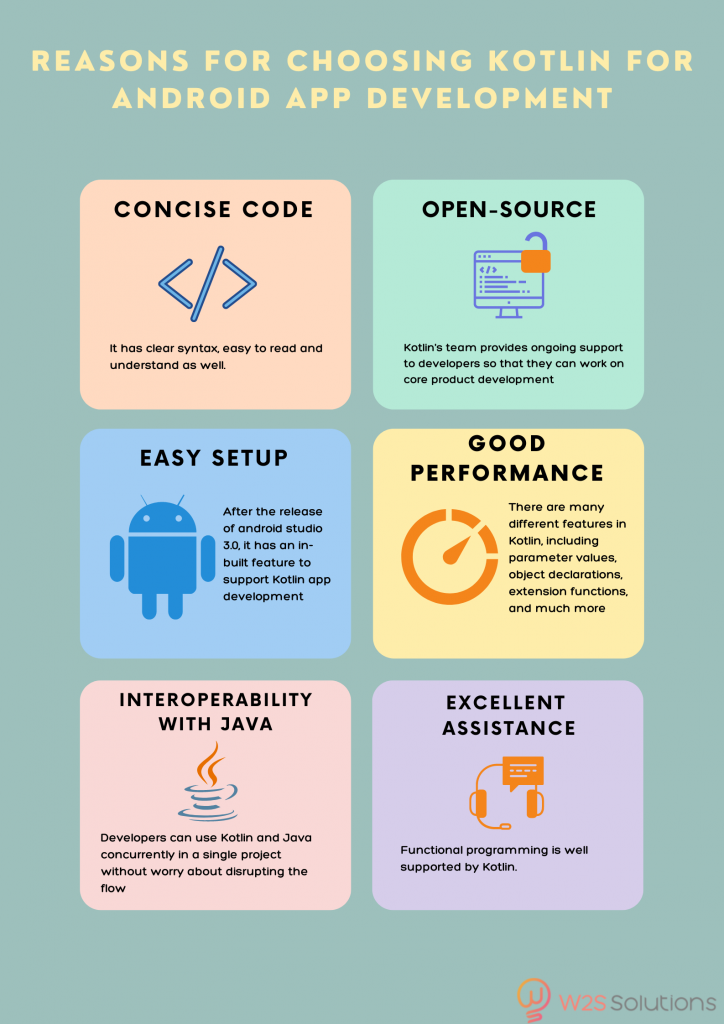
Concise code
To accomplish any task, Java often requires numerous lines of code in a specific order. The main benefit of using Kotlin for android app development is that you can achieve the same goals with fewer lines of code. By eliminating long-line code, developers can focus on more important issues that are more likely to contribute to the success of the project. It is easy to read and understand Kotlin code because it has a clear syntax. The inter-developer maintainability of the code is enhanced greatly as a result.
Also, Android apps developed in Kotlin are smaller because their code volume is lower. Having fewer lines of code also allows for a faster production rate because mistakes are more easily detected.
Open-source
Kotlin was established as an open-source language in 2012. Kotlin’s team provides ongoing support to developers so that they can work on core product development. High-quality applications can be created with Kotlin programming language.
Easy setup
To add Kotlin to Android application development in the past, Android app developers had to use a plugin. Since the release of Android studio 3.0, developers no longer need to use a plug-in to add Kotlin programming support, since the update now gives a built-in feature to support Kotlin application development.
Good performance
The byte code structure is mainly responsible for how quickly Kotlin applications operate. Lambda functions run more quickly thanks to Kotlin’s support for inline functions. The process of Android app development with Kotlin offers a wide variety of useful features that speed up routine development tasks when compared to Java. There are many different features in Kotlin, including parameter values, object declarations, extension functions, and much more. This enables Kotlin to effectively maintain the code base while also accelerating the event time.
Interoperability with Java
Since Kotlin and Java are completely compatible, developers may use both languages simultaneously in a single project without having to worry about the flow being disrupted. All they need to do is add extra tools and the necessary frameworks without interfering in the current process. You can use all of your Java code as well as Kotlin functions in your Java project. This means you may quickly and cleanly call your Java code from a Kotlin program or the other way around. Because Kotlin is designed to be entirely backward compatible with Java, developing Android apps with Kotlin is incredibly simple and convenient. Therefore, you can mix and match code as necessary without your app breaking, as opposed to completely rewriting your Java application in Kotlin. The Java code can then be later converted to Kotlin code.
Easy to learn
It is simple to learn and create Android applications using Kotlin, making it one of the best programming languages. A user can easily understand the code without the need to practice it repeatedly since it was designed in such a way. Kotlin is easier to use than Java when it comes to creating classes and writing syntax.
Excellent assistance
Kotlin’s inlining allows it to perform better than Java. Functional programming is well supported by Kotlin, as well. You won’t be alone in the market because there will be a wealth of resources, forums, and examples.
Interesting Facts about Kotlin
Kotlin is a dynamically typed, cross-platform language with type inference. Considering the advantages of Kotlin language in the Android app development era, you would do well to learn about them. The following illustrations explain the interesting facts about kotlin.

On the 12th anniversary of the initial commit in the Kotlin repository, here is the tweet from the official account!
This week was the 12-year anniversary of the initial commit in the Kotlin repository! Here are 12 interesting facts about Koltin.?
Retweet and share your passion for your favorite language!❤️
1️⃣ Each month over 1,000,000 developers edit Kotlin code.?????https://t.co/ySiEp8TbaA
— Kotlin (@kotlin) November 11, 2022
Business benefits of switching to Kotlin
The app’s maintenance will be easier and more affordable as it becomes more fault-proof with Kotlin. In addition to being more compact than Java, Kotlin also speeds up development; rough estimates indicate it can cut up to 40% of code lines. As Kotlin becomes more universal, your app should be able to move from one platform to another. Furthermore, a new framework attracts talented software developers to adopt this new technology due to its efficiency. A simpler and easier-to-understand code reduces the likelihood of errors by making it more difficult to commit them, and much easier to detect them.
Conclusion
As more businesses use the language, there is a good chance that demand for Kotlin app development will exponentially increase. Kotlin is completely compatible, making it simple for businesses to switch over for Android application development. Since it increases productivity and is an effective programming language, the time has come to try learning Kotlin for development processes and take advantage of new opportunities in Android mobile application development and accelerate their learning curve. If you switch to Kotlin, keep in mind to plan it carefully and draw on the skills and experience of developers. The Kotlin programming language is suitable for developing Android apps. Getting started with Kotlin android development services is easy – simply get in touch with one of the best android app development service providers, Way2Smile Solutions, for more information on how you can use Kotlin for your Android app development projects.
Frequently asked questions (FAQs) on Kotlin App Development
A. In the case of a business, switching to new software is a deliberate decision.
- The Assistance
It will also provide companies with better technical support and other capabilities. Furthermore, it will facilitate information sharing among members of the Android app developers group.
- Low development and upkeep costs
Lower development and ongoing maintenance costs for Kotlin projects are a huge benefit for any company. Kotlin has a plethora of excellent language features, as well as simplicity, which ensures better quality and a faster turnaround time.
- Easy migration
Finally, businesses can easily transition to Kotlin, making the entire process easier for everyone. This, combined with simple language learning, removes any barriers to success

Mobile apps are really becoming competitive today, and there are more and more opportunities growing for businesses to stay unique in the marketplace. Your mobile application is the first point of contact with your audience. It’s the place where they can find out more about your business, ask questions, and make purchases. In order to stand out from the crowd, you need to make your application easy to use, useful for your target audience, and also be open to their feedback to improve your app’s performance and quality.
The mobile app market has been on an upswing for business since the beginning of the decade. As more and more people make their way through the digital age, they have come to rely on their smartphones to help them do everything from banking to shopping. You have a lot of choices to explore various industry needs and make an ideal decision to build a challenging app.
Fortunately, there are many things you can do to help narrow down the field and then choose the right option for your business. When it comes to mobile apps, staying competitive in the market can be a challenge. In this day and age, there are many mobile applications available for users to use from the app store.
If you want your app to be successful, it needs a well-thought-out strategy to attract your customers. Also, there are a lot of factors you need to consider when making your app more attractive to users, including how simple it looks, what features are added based on your customer’s needs, and whether or not it’s engaging.
What are the ways to propel your mobile app to the top of the market?

-
Start with customer research
The main reason why customer research is important for building mobile apps is that it helps you understand your customers and their needs. If you don’t know them, how can you possibly create a product that will solve their problems or fulfil their wants? Before you can create an effective and helpful mobile app, you must understand your target audience. It would be preferable if you knew more about them and what they wanted from your app so that it could benefit your business. Also, update your mobile app regularly to attract new customers and manage the existing ones to stay current with market trends.
-
Focus on creating a mobile-friendly app
Your customers will expect a seamless experience across devices, and businesses that don’t meet their expectations are at a huge disadvantage. Mobile-friendly apps are a one-stop solution for your business since they allow you to reach more customers and make more capital. It’s important for you to focus on developing a mobile-friendly app that helps you with customer retention and drives up engagement with existing customers who use your app on a regular basis to access required information or services based on their needs.
-
Give importance to the app’s design quality
The mobile app design quality is a very important factor when it comes to the successful launch of your new product or service. When you have excellent design quality, your mobile apps will look attractive, which will help you gain more customers and increase your sales as well. It also improves their trust in your brand and makes them feel comfortable using your apps.
-
Leverage the latest technology for mobile app development
As the mobile app landscape continues to change, it’s important for enterprises to stay on top of the latest trends and technologies. Mobile apps are now an integral part of businesses marketing strategies, and the demand for mobile technology is only increasing. Your business should leverage new technology for mobile app development since it will help you become more widespread, keep you updated with new developments in the industry, improve user experience, make business processes more efficient, and increase your customer base.
-
Choose a reputable mobile app development company
You should choose a reputable mobile app development company because it’s important to work with a company that has been around for long enough to have earned the trust of its clients and the industry in general. They will provide you with a detailed project outline, including the app development process, budget, tools and technology used, time frame requirements, and adding features. If they don’t offer this information upfront, it’s likely that they are not as good as they say they are, or you’ll end up paying more than necessary for services that aren’t worth what you’re paying for them.
Final Thoughts
Mobile apps are a great way to keep up with your customers and provide them with what they need. However, you have to ensure that your app is on the cutting edge of technology to keep up with their needs. By doing this, you’ll be able to tailor your app specifically for each user and make sure that they’re satisfied with its use. If you want to stay competitive in the market, hire a mobile app development company that offers affordable mobile app solutions with exquisite features based on your business requirements.

The latest iOS update is on the top of the list of influencing factors for the iOS app development trends for 2026 since it has always offered exquisite features & updates. We all know that Apple’s latest iOS 16 updates was rolled out on September 12, 2022, which improved the overall design and development quality of apps, including its digital wallet “Apple Pay”, health and fitness, Maps, AI chatbot “Siri” and much more. iOS app development trends are getting better every year, while also expanding the digital space for small-to-large-scale enterprises to explore more opportunities in the app development realm.
iOS mobile app development is advancing at breakneck speed in the modern world. The iOS platform is a popular choice for app developers and businesses because it provides a straightforward experience for users, who are able to access their apps through Apple devices like iPhones and iPads. Besides, there is an ever-growing fanbase for Apple products, not just in the USA, but the rest of the world as well.
Many enterprises are now trying to elevate their business, specifically with iOS app development, by staying updated with the latest trends, understanding society’s needs, and offering unique mobile app solutions for iOS patrons.
What is the latest version of iOS for Mobile Apps?
Apple’s latest version, the iOS 16 software update, was released at the end of the third quarter of 2022 and offers best-in-class features to enhance the overall performance of the mobile phone, including the apps. It has used various technologies, such as 5G, AI, IoT, and others, to advance mobile app operations and make everyone’s lives easier.
The features of iOS 16 for mobile apps include a better interface, high-end security, improved “Apple Pay” wallet, Maps, “Siri” Chatbot powered by AI, etc. This is why various industries, from education to healthcare, probably prefer iOS mobile apps to boost their operational efficiency, and productivity, generate more capital, and also make their brands stronger.
What are the top iOS app development trends for 2026 and beyond?
Here is the list of top iOS trends for 2026 and beyond that, you should look at before building your next iOS mobile app.

Expanding the iOS ecosystem
The Internet of Things (IoT) is the latest buzzword for iOS app development. It’s being used to describe everything from connected fridges and cars to smart home devices, wearables, and even health trackers. But what does this mean for iOS mobile app development? It means you need to be thinking about how your app can use connectivity to make users’ lives easier. With iOS app development features powered by IoT technology, you can control anything from your home appliances to your car, enabling voice commands or even scheduling tasks.
Rise of Virtual Assistant
Siri, the virtual assistant in Apple’s iOS mobile operating system, has been a hit since its launch in 2011. Now, with the release of a new generation of smartphones with chatbots, the VA has moved to the forefront of mobile computing. In its newest incarnation, Siri is able to leverage the capabilities of artificial intelligence (AI) to answer questions and make suggestions when you ask it. Siri can handle multiple conversations at the same time, unlike humans, who can only handle one conversation at a time. It can help answer questions about products or services, schedule appointments, place orders, and more.
Gear up for stronger network connectivity
5G is an exciting new development in the world of iOS mobile apps and can help improve the user experience for your users. With 5G, iOS apps can use more bandwidth, faster speeds, and higher reliability when communicating with their users. It will allow apps to run more smoothly and quickly. 5G focuses on offering a seamless connectivity experience for users and is poised to redefine all industries.
Get immersed in the virtual space
One of the more popular mobile technologies on the market right now is AR/VR. These trending technologies are perfect for users who want to make their lives more enjoyable and exciting by adding a new dimension to them. They allow users to interact with virtual objects in real life and see those objects in a whole new light. Such apps can be used to create a virtual tour of your business, sell products or services, use location-based marketing (LBM), etc. For example, you can even plan interior design for a better virtual view with AR/VR-powered iOS apps rather than visiting your property site and planning everything.
Shaping the App’s Security
The iPhone has become a powerful mobile device with amazing applications. You can do so much more with it than you ever thought possible, but you have to make sure that your app isn’t compromised by hackers. The iOS 16 update delivers high-end security for iOS mobile apps to secure their users’ connections. Apple is well known for security, and it’s very difficult to hack its smartphones or tablets.
Craft the iOS app swiftly with code
Swift for mobile apps is a programming language that was developed by Apple for iOS devices. It is a very simple and easy-to-learn programming language. The performance of your app will be much better because Swift was created specifically for mobile devices and it uses lesser memory. It includes everything you need to write apps, including an integrated editor and a suite of powerful tools that will help you get started with mobile app development.
Final Thoughts
iOS mobile app development has a great future for both enterprises and developers. The best way forward is to build your iOS mobile app with a clear vision and to stay current with the latest trends in order to stand out from the competition. Way2Smile is a globally renowned iOS app development company that offers a wide range of mobile app solutions at an affordable cost, ensuring you achieve your goals.

Android is a popular operating system which holds great value among businesses today; and because of this, a great platform for enterprises and developers to generate more revenue. If you’re looking to build Android apps for your business, you’ve probably heard of a few programming languages. But which ones are the best? In this blog, we’ll go over the top programming languages for Android app development in 2026. We’ll start by looking at what makes each language unique and why it’s perfect for your Android app development project.
Android apps provide a great return on investment for businesses as they are easy to build and have a greater market reach. Businesses are now relying on mobile applications to solve customers’ everyday problems. The importance of choosing the right programming language for your Android app development lies in your strategy to build innovative apps easily and go to market and scale and speed.
Which programming language is used for android application development in 2026?
Here’s the list of the most widely used programming languages for Android app development:
#1. Java
Java is the first official programming language used by businesses and developers for custom Java development and to build mobile applications on Android. Also, the Android platform consists of APIs and Java libraries for you to write code or make use of them to build top-notch apps.
Although it is quite complex to understand this programming language, it provides robust features such as server-side programming and advanced program security to assist you in developing innovative Android apps, server apps, cross-platform apps, and so on. The reason why you should prefer the Java programming language for your Android app development project is that it’s highly flexible, portable, reusable, and versatile.
#2. Python
Python is the most popular open-source programming language among businesses to build best-in-class Android apps for smartphones and tablets. Python is well known for its simplicity and versatility. It can also be used to develop other applications, such as web development, desktop apps, and server-side scripting. Today, many Android app development companies prefer Python for developing mobile apps.
It offers a wide range of libraries and frameworks that allow you to use any feature of the platform in your app. The libraries available for creating Android apps using Python make it easier for you to create apps without having to worry about the underlying operating system or framework being used on the device because your Android application will run on top of the tech ecosystem.
#3. Kotlin
Kotlin is a programming language that has been gaining popularity in the past few years. It’s a modern, clean, and safe alternative to Java. It’s focused on making it easier for businesses and developers to write code more concisely and readable while also giving you the power to use Java libraries.
It is one of the best programming languages used by top companies since it will help you minimize errors in the code, improve compiler performance, alter changes in the existing Android apps, etc. You can use Kotlin for Android app development to have access to extensions to the standard library, including collections like List and Set, which makes it easy to use other libraries written in Kotlin without needing to rewrite your code.
#4. C++
Many businesses and developers use C++ for Android App Development since it is one of the most widely used coding languages. It can be compiled down to machine code before running on the device. It is designed to be highly efficient, and it supports object-oriented and imperative programming styles.
It has a large standard library and a number of third-party libraries, making it easy to develop applications with a high level of functionality. C++ is an object-oriented language, which means that it uses classes and objects to represent data. This makes it easy to create reusable code and write programs that are more efficient than their counterparts written in other languages.
#5. C#
C# is a general-purpose, object-oriented programming language. It is used to develop computer software applications as well as Android apps for mobile devices. It supports multiple programming paradigms like imperative, declarative, and functional. It has been around for more than 20 years, and it has become the most popular choice for developing Android apps because of its cross-platform capabilities.
One of the most important things that makes C# an excellent choice for Android app development is that C# has access to the.NET framework. It provides a lot of tools and libraries to help you write code for Android apps, but it also includes classes and interfaces that can be used for debugging and testing.
#6. JavaScript
JavaScript is the most popular programming language for Android app development. It uses JavaScript to communicate with the Web and sometimes with other apps on the device. The language is known for its ease of use and its ability to interact with other languages. Its frameworks are well-suited for creating mobile applications that run on any Android platform.
The main advantages of using JavaScript for Android apps are that it can be used to detect device capabilities, improve performance, and has the ability to run on a wide range of devices and platforms. Instead of having to create two entirely different apps, you can create cross-platform mobile apps thanks to JavaScript.
#7. Corona
Corona is one of the best Android app development languages as it is designed to be quick and easy to use while being powerful enough to handle most Android application needs. It is based on Lua but has a new interpreter written in Java.
It’s lightweight and easy to use, so you don’t have to worry about memory management or performance issues. Corona allows you to write code for Android apps once and run them on multiple platforms without having to learn different languages. It supports multithreading, so your code will run faster when compared to other languages.
#8. TypeScript
Typescript is an open-source programming language developed by Microsoft. It is a modern version of JavaScript that can be used for both client-side and server-side applications. However, JavaScript has a number of constraints that make it very challenging to use it as a programming language for creating complicated mobile applications. If you’re looking for an advanced way to create apps for your business, then you should go for TypeScript.
#9. Dart
Dart is a programming language that is designed to run on the Android platform. It was created by Google and has been around for about 8 years now. It’s an open-source language, which means that anyone can use it and customize it to suit their needs for building Android apps.
The Dart programming language has many benefits for your business, including being strongly typed, having an emphasis on functional programming (FP), being very expressive, and the Dart Virtual Machine (VM) allows programs to run on multiple operating systems.
#10. Ruby
Ruby has been used to build applications for Android since its creation in 1996, and today it powers many of the most popular apps in the Play Store. It’s flexible, simple to learn, and open source, so you can modify it as you need to fit your Android application’s needs. Ruby is a powerful and expressive programming language that lets you develop Android apps quickly and easily.
How to pick the right programming language for your Android app development project?
Choosing the right programming language for your Android app development project is important. You’ll want to choose one that can support the features you need and one with which you can work efficiently. The best languages tend to be those that are fast-moving, well-designed, and easy to use. The Android development process is simple and has libraries that are easy to integrate into other programs and platforms, Choosing the right tools, especially from the top 10 hardest programming languages list, can impact how efficiently you build and scale Android apps.
Also, you need to know these three things before you get started with mobile app development:
- The type of app you’re building: Does it need to be simple and fast? Or do you want to make something that’s more complex and takes time to develop?
- The number of people involved in the project: If there are many people who will be using your app, then they’ll need to have access to different versions of the same code, which means they’ll be more likely to run into problems if they’re not working in the same language as everyone else. On the other hand, if there are only a few people involved in the project, then everyone will be working on the same version of the code at all times, which makes it easier for them to work together on fixing bugs or adding new features.
- The amount of time that needs to be spent on developing your Android app: If you need something built quickly, then it might not make sense to pick something that is too complicated or difficult to handle.
Final Thoughts
Android app development has become a booming business around the world. With so many languages available, it can be difficult to choose which language is best for your project though. Now, you can make your decision with the above-compiled list of top programming languages for Android app development based on their popularity, availability, and what you need from this programming language. Way2Smile is a leading mobile app development company in Chennai that offers top-notch mobile app solutions built with the best programming languages, tools, and technologies at a low cost for governments, startups, and enterprises. If you are looking for mobile app development services, you might want to have a quick conversation with us.

The foundational unit of our current digital ecosystem is the mobile app. It allows the user to tap into the power of digital through a simple interface and perform a variety of functions- from simple to complex, the present mobile app can do anything and everything! Because of its simplistic nature, a user prefers a mobile application over any other means to leverage digital. Of course, web applications, websites, and custom software are growing drastically, but given the choice, a user is more likely to choose a mobile application as their primary platform to access the digital world. Thanks to our enhanced hardware capabilities!
Android, in particular, is one of the many mobile operating systems that has gained a massive following ever since it was launched in the market.
As of August 2022, Android has a market share of a whopping 70%, making it the most dominating mobile operating system in the world.
Naturally, the demand for android app development increased dramatically, as brands got a greater ROI for a little (relatively!) investment, and more importantly, they could easily connect with a majority of their target audience through an android app than they would otherwise.
Either way, it presents a real opportunity for brands to change their narrative. To help you understand more about the android app development process, we collaborated with our senior android app experts to craft this article. Feel free to check it out!
Before we understand the process!
Due to the huge demand for android app development in the market, there are many IT firms and app development companies that popped on the radar in the last few years. While different companies may use different methodologies, we compiled the list based on the industry standard practices and of course, our 20+ years of expertise in this field. If you need more info, our digital experts would be more than happy to help you!
Step-by-step process of android app development
The key stages of android app development are,
- Idea
- User experience
- Designing
- Development
- Beta release
- Launch

IDEA
You’ve to start with the idea. Before you dive into the process of building your android application, you need to have a 360-degree understanding of your mobile app idea. The crux of your idea will lay the foundation of your application, so, it’s important to optimize your idea as far as you can. Usually, we suggest our clients consult with our industry experts to help them with this process. Almost all of them said that it helped them get the minute details right, as they tend to overlook them
USER EXPERIENCE
Once the idea is complete, the next step is to define the user experience. User experience, undoubtedly, plays a huge role in the success of your android application, and slacking here would be the worst idea! As the name suggests, this is how your user gets to experience your product or service, so this should be on your priority list. You need to understand your target audience and their psychology to craft the ultimate user experience. If done right, your app will reach millions in just a short window. In just 3 months since the launch of Instagram, the app had 1 million users! The secret sauce? Well, you guessed it right!
USER INTERFACE / DESIGN
The next step in the android app development cycle is to give life to your user experience- designing. People and businesses often think of design as just the aesthetic element of their application, but if you look at some of the most successful android applications ever, they view design as equal parts aesthetics and problem-solving, too! The purpose of a design in app development is to solve practical user problems. It’s like a map that guides the user through your digital environment. Design can also be a powerful tool to convey your brand tone to your audience without trying too hard, helping you distinguish yourself from the rest of the competition.
DEVELOPMENT
This is where the magic happens. Your odds of building a better app increase when your development team is diverse and proficient across various technologies. The most commonly used programming language for android app development is Kotlin, but developers may suggest different technologies based on the complexity of your project. It is important to keep the development process straightforward and simple. Apps evolve with consumer needs, and it’s important for developers to understand the business side to deliver a resilient and high-functioning application. For instance, we at Way2Smile Solutions deploy cross-functional teams that include project managers, industry experts, and senior developers to get this perspective right. This contributes to creating an air-tight mobile app development process/strategy.
BETA RELEASE
Once the development is done, it’s important for you to understand how your application functions under real-time scenarios. While quality analysts will check for any bumps on the development and design side, nothing comes close to beta testing your application. The application will be released to a smaller market, and developers will analyze the real-time performance of your application. Your audience may use different devices, may subscribe to different networks, may use your application differently, etc. Developers will understand how the app performs under pressure and will tweak the application to meet this user behavior. For one of our retail clients, beta testing enabled them to completely reposition their product, helping create multiple channels of revenue. This was possible only from the hands-on insights our developers got from the beta releases.
LAUNCH
Your mobile application development company will help you with the launch of your application. When it comes to launching an android application, the most preferable choice is to go with the Google Play Store. Quality analysts will perform a final check to ensure that your android application performs optimally after the launch.
Being a major league android application development services provider in Chennai, Way2Smile Solutions is in the IT industry for more than 20 years, and we have worked with a wide range of organizations, including startups, enterprises, and government agencies. We have a strong clientele across industries, and we elevate the scope of your android application by integrating it with influential technologies like Artificial Intelligence(AI), Machine Learning(ML), Big data, Augmented Reality(AR), Virtual Reality(VR), and many other in the market. You can take a look at some of our notable works, here.
You can also get started with your mobile app development process by connecting with our tech experts.


